
Medium
Classification
Department
Smithsonian Collection
Museum
Smithsonian American Art Museum
Credit
National Portrait Gallery, Smithsonian Institution; gift of Mr. and Mrs. Paul Mellon
Accession Number
S/NPG.74.39.12.20
Rights
Public Domain
Tags
Art Historical Context
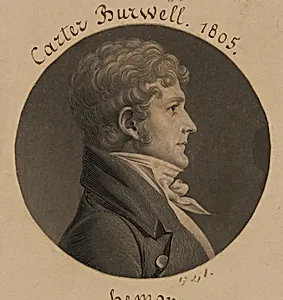
In 1805, French-born artist Charles Balthazar Julien Fret de Saint-Mé created this striking profile portrait print of Carter Burwell, a prominent early American figure. Saint-Mémin, who fled the French Revolution and settled in the United States, specialized in precise, cameo-like silhouettes that captured the likenesses of the nation's emerging elite. This work, housed in the Smithsonian American Art's collection (with credit to the National Portrait Gallery via a gift from Mr. and Mrs. Paul Mellon), exemplifies his role in documenting the young republic's leaders and planters. Saint-Mémin's innovative technique involved the physiognotrace—a mechanical device that traced profiles onto paper, which were then engraved and hand-colored for distribution as affordable prints. This method blended Enlightenment precision with neoclassical elegance, making high-quality portraits accessible beyond oil paintings reserved for the wealthy. Produced just two decades after American independence, the print reflects a era of nation-building, where such images served as visual records of social status and identity. Today, this piece offers a window into early 19th-century American society, highlighting Burwell's place among Virginia's influential families. Its survival in the Smithsonian underscores the enduring value of printmaking in preserving history for future generations.