
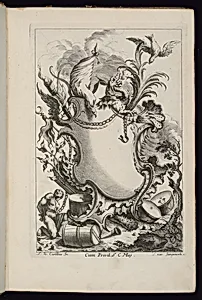
Cartouche with Chained Figure
Medium
Bound print
Classification
Bound print
Department
Smithsonian Collection
Museum
Smithsonian American Art Museum
Credit
Purchased for the Museum by the Advisory Council
Accession Number
1921-6-281-4
Rights
Public Domain
About this artwork
Research in Progress
Art Historical Context
François de Cuvilli the Elder (1695–1768), a Belgian-born architect and designer who thrived in Germany, was a master of the exuberant Rococo style during the early 18th century. primarily in Bavaria, he created lavish interiors and decorative designs for European courts, blending playful ornamentation with elegant asymmetry. His *Cartouche with Chained* (1738) this flair through a bound print—a printed design typically bound into volumes for architects, designers, and collectors to study and replicate. A cartouche, the ornate scrolled frame at the center of this work, served as a decorative enclosure for inscriptions, coats of arms, or titles in architecture and printmaking. Here, it frames a chained figure, evoking allegorical themes of captivity, restraint, or triumph over adversity—common motifs in Baroque-to-Rococo transitions. As a bound print, likely an etching or engraving, it highlights the era's innovative reproductive techniques, allowing intricate designs to disseminate widely across workshops and palaces. Acquired by the Smithsonian American Art Museum through its Advisory Council, this piece offers a window into Cuvilliés' influence on ornamental arts. Though research continues, it invites visitors to ponder the symbolic chained figure amid swirling Rococo flourishes, bridging fine art with functional design in 18th-century Europe.