
Carved Policeman
1935/1942
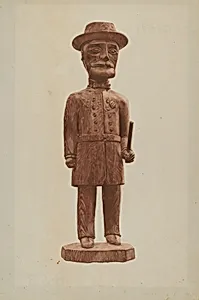
Medium
watercolor, graphite, and colored pencil on paper
Dimensions
overall: 35.7 x 24.3 cm (14 1/16 x 9 9/16 in.)
Classification
Index of American Design
Department
CG-W
Museum
National Gallery of Art, Washington, D.C.
Credit
Index of American Design
Accession Number
1943.8.10185
Rights
Public Domain
Art Historical Context
Welcome to the National Gallery of Art's showcase of American design! *Carved Policeman* (1935/1942) by Mildred E. Bent is a vibrant rendering from the Index of American Design, a remarkable New Deal-era project. Created under the Works Progress Administration (WPA) during the Great Depression, the Index employed artists to meticulously document everyday American folk art, crafts, and decorative objects. Bent's precise depiction captures a whimsical carved wooden figure of a policeman—likely a playful folk carving from the vernacular tradition—preserving its charm and cultural snapshot for future generations. Rendered in watercolor, graphite, and colored pencil on paper (35.7 x 24.3 cm), the work exemplifies the Index's signature style: hyper-detailed illustrations that emphasize texture, color, and form with scientific accuracy. Watercolor brings lively hues to the figure's uniform and features, while graphite and colored pencil add fine lines and shading, mimicking the original sculpture's hand-carved essence. This mixed-media approach not only highlights the artisan's skill but also underscores the democratic spirit of American folk art, celebrating everyday creativity amid economic hardship. As part of the CG-W department collection, *Carved Policeman* invites us to appreciate how ordinary objects reflect national identity and ingenuity. A delightful nod to 20th-century Americana!
About the Artist
Mildred E. Bent · 1855–present
Mildred E. Bent remains one of the more elusive figures in early twentieth-century American art, her biographical details largely undocumented in the historical record. She appears to have worked within the traditions of her era, producing a body of work substantial enough to leave a meaningful impression in the collections that have preserved her name, even as the personal circumstances of her tr...