
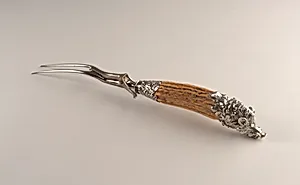
Carving Fork with Antler Handle and Boar's Head Terminal
Classification
cutlery
Department
Smithsonian Collection
Museum
Smithsonian American Art Museum
Credit
Bequest of Julian Clarence Levi
Accession Number
1972-5-3-c
Rights
Public Domain
About this artwork
Research in Progress
Art Historical Context
Crafted by the renowned Gorham Manufacturing Company of Providence, Rhode Island—founded in 1818 and a leader in American silverware—this *Carving Fork with Antler Handle and Bo Head Terminal* dates to 1900. Gorham was celebrated for its exquisite metalwork, blending industrial precision with artistic flair during the Gilded Age, when opulent dining sets symbolized wealth and refinement among America's elite. The fork's design marries natural elegance with bold symbolism: a sturdy antler handle evokes rustic hunting traditions, while the boar's head terminal at the end adds a fierce, trophy-like flourish. This fusion of organic materials and detailed carving reflects early 20th-century tastes for naturalistic motifs, possibly nodding to Renaissance Revival influences popular in Gorham's oeuvre. As functional cutlery, it would have graced formal tables, elevating everyday rituals to art. Now in the Smithsonian American Art Museum through the bequest of Julian Clarence Levi, this piece highlights the craftsmanship of American decorative arts at the turn of the century. Though research continues, it stands as a tangible link to an era of innovation in luxury goods, inviting us to appreciate the artistry hidden in household heirlooms.