
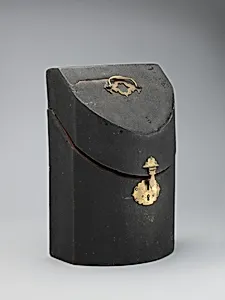
Case
Unknown Artist
late 18th century
Medium
Wood, shagreen; brass
Dimensions
Overall: 12 1/2 × 8 in. (31.8 × 20.3 cm)
Classification
Metalwork-Silver
Culture
British, Sheffield
Department
European Sculpture and Decorative Arts
Museum
Metropolitan Museum of Art, New York, NY
Credit
Bequest of W. Gedney Beatty, 1941
Accession Number
41.160.93
Rights
Public Domain
Art Historical Context
This elegant "Case" from late 18th-century Britain exemplifies the refined craftsmanship of Sheffield, a for innovative metalwork and silver production. Crafted from wood covered in shagreen—a textured stingray skin prized for its and exotic appeal—and accented with brass, the case measures a compact 12½ × 8 inches. Though its exact purpose remains a mystery (likely for housing silverware or personal items), its classification under metalwork-silver highlights Sheffield's mastery of techniques like Sheffield plate, where silver was fused to copper or brass bases for affordable luxury. In the Georgian era, such decorative cases reflected the era's growing middle-class taste for functional yet opulent objects, blending utility with neoclassical elegance. Shagreen, imported via trade routes, added a tactile, exotic flair to British workshops, symbolizing global commerce and colonial influences. Produced anonymously in Sheffield's bustling manufactories, it showcases the region's shift from handmade artisanal work to proto-industrial precision. Today, this piece, bequeathed to the Metropolitan Museum of Art in 1941 by W. Gedney Beatty, invites us to appreciate the unsung artistry of everyday luxury, bridging domestic life and high design in European decorative arts.