
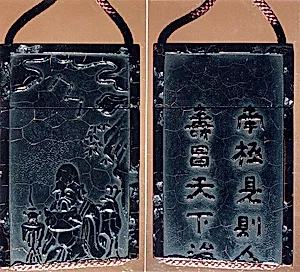
Case (Inrō) in the Shape of an Ink Stick with Design of God of Longevity (Jurōjin), Reading beneath a Star Constellation (obverse);Twelve-Character Inscription (reverse)
19th century
Medium
Roiro (waxen) lacquer with black hiramakie sprinkled and polished lacquer and takamakie sprinkled and polished lacquer relief; Interior: roiro; Netsuke: lacquer in shape of a worn ink stick; Ojime: black lacquer bead
Dimensions
2 5/16 x 1 1/2 x 11/16 in. (5.9 x 3.8 x 1.7 cm)
Classification
Inrō
Culture & Period
Japan · Meiji period (1868–1912)
Department
Asian Art
Museum
Metropolitan Museum of Art, New York, NY
Credit
The Howard Mansfield Collection, Purchase, Rogers Fund, 1936
Accession Number
36.100.253
Rights
Public Domain
Tags
Art Historical Context
This exquisite *inrō*, crafted by Shibata Zesh in Japan's Meiji period (186–1912), takes the form of a miniature ink stick—a clever nod to the scholar's tools it was designed to carry, such as seals, inks, and medicines Worn suspended from a kimono sash via its lacquer netsuke (shaped like a worn ink stick) and ojime bead, this case exemplifies the refined functionality of Edo-period accessories transitioning into the modernizing Meiji era. On the obverse, the God of Longevity, Jurōjin—one of the beloved Seven Lucky Gods—sits reading beneath a starry constellation, symbolizing wisdom, prosperity, and eternal life. Zeshin, a master lacquer artist, elevates the object through virtuoso techniques: shimmering *roiro* (waxen black lacquer) forms the glossy base and interior, while *hiramakie* (flat sprinkled gold lacquer, polished smooth) and *takamakie* (raised sprinkled relief) create textured depth for the figures and stars. These methods, polished to a mirror-like sheen, highlight Zeshin's innovative realism, making lacquer mimic ink's matte texture and celestial glow. The reverse bears a twelve-character inscription, adding poetic mystery. Housed in the Metropolitan Museum of Art's Asian Art collection (from The Howard Mansfield Collection, 1936), this 2⅜-inch treasure reflects Meiji Japan's fusion of tradition and artistry, inviting viewers to ponder longevity amid the cosmos.
About the Artist
Shibata Zeshin · 1807–1891
Japanese, 1807–1891