
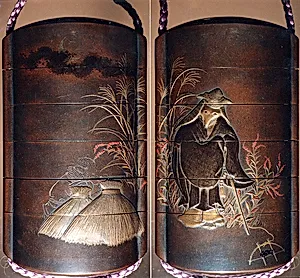
Case (Inrō) with a Fox from the Kyōgen Play The Fox Hunter (Tsurigitsune); Hunter behind Haystacks from the Kyōgen Play "Hakuzōsu" (reverse)
19th century
Medium
Gold and silver maki-e with colored lacquer on black lacquer Ojime: gilded metal with fox-monk Netuske: Lacquer oval box with diamond floral design (signed Kiyoharu)
Dimensions
3 11/16 x 2 1/16 x 1 1/8 in. (9.4 x 5.2 x 2.9 cm)
Classification
Inrō
Culture & Period
Japan · Meiji period (1868–1912)
Department
Asian Art
Museum
Metropolitan Museum of Art, New York, NY
Credit
The Howard Mansfield Collection, Purchase, Rogers Fund, 1936
Accession Number
36.100.252
Rights
Public Domain
Tags
Art Historical Context
This exquisite *inrō* (a small, lacquered case for carrying personal items like medicines or seals in a kimono sleeve) was crafted by Shibata Zeshin, one of Japan's greatest lacquer artists of the 19th century. Working during the Meiji period1868–1912), Zeshin mastered *maki-e* techniquessprinkling fine gold and silver powders onto wet black lacquer, then layering colored lacquers for vivid depth and luminosity. At just 3 11/16 inches tall, this compact masterpiece exemplifies the refined elegance of Japanese decorative arts, blending functionality with artistry. The front depicts a sly fox from the Kyōgen play *Tsurigitsune* (The Fox Hunter), a comedic interlude in Noh theater where shape-shifting foxes trick humans. The reverse shows a hunter hiding behind haystacks from *Hakuzōsu*, evoking themes of mischief and pursuit central to these folkloric tales. Zeshin's intricate designs capture dynamic movement and humor, with shimmering gold accents bringing the scenes to life against the glossy black ground. Completing this ensemble are a gilded metal *ojime* (cord fastener) featuring a fox disguised as a monk—a nod to fox folklore—and a lacquer *netsuke* oval box signed by Kiyoharu, adorned with a diamond floral motif. Acquired through The Howard Mansfield Collection in 1936, this *inrō* highlights Meiji-era innovation, where traditional crafts met modern tastes, offering visitors a playful window into Japan's theatrical and artistic heritage.
About the Artist
Shibata Zeshin · 1807–1891
Japanese, 1807–1891