
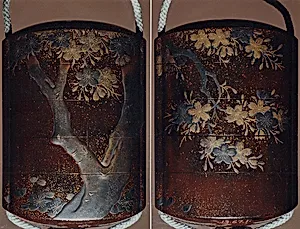
Case (Inrō) with Design of a Flowering Cherry Tree
Unknown Artist
19th century
Medium
Lacquer, dark brown, nashiji, gold and silver hiramakie; Interior: nashiji and fundame
Dimensions
2 15/16 x 2 1/16 x 15/16 in. (7.5 x 5.2 x 2.4 cm)
Classification
Inrō
Culture & Period
Japan · Edo (1615–1868) or Meiji period (1868–1912)
Department
Asian Art
Museum
Metropolitan Museum of Art, New York, NY
Credit
Rogers Fund, 1913
Accession Number
13.67.1
Rights
Public Domain
Tags
Art Historical Context
This exquisite *Case (Inrō) with Design of a Flow Cherry Tree* is a example of Japanese lacquerware from the 19th, likely from the late Edo period (1615–1868) or early Meiji era (1868–1912). Inrō were small, tiered containers worn by men suspended from their kimono sashes via cords and secured with ornate netsuke. They served as portable medicine boxes or holders for seals and tobacco, evolving into fashionable accessories that displayed wealth and taste among samurai and merchants. Crafted in dark brown lacquer with nashiji—a shimmering "pear-skin" ground of sprinkled gold and silver flecks—the exterior features gold and silver hiramakie, a technique where powdered metals are sprinkled onto wet lacquer and burnished flat for a luminous effect. The blooming cherry tree motif, rendered delicately, evokes sakura's fleeting beauty, a profound symbol in Japanese culture of life's transience (mono no aware). The interior's nashiji and fundame (a matte gold or silver base) adds subtle luxury. Measuring just under 3 inches tall, this inrō highlights the unparalleled precision of Edo-Meiji artisans, whose lacquer techniques influenced global decorative arts. Acquired through the Rogers Fund in 1913, it's a gem in the Metropolitan Museum of Art's Asian Art collection, inviting us to ponder the elegance of everyday objects turned art.