
Case (Inrō) with Design of a Teahouse (obverse) Three Travelers En Route (reverse)
19th century
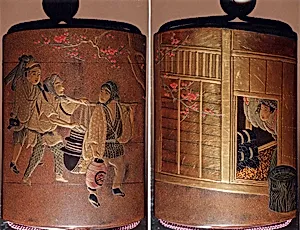
Medium
Lacquer decorated with sprinkled hiramakie lacquer, sprinkled and polished takamakie lacquer relief, and nashiji (pear skin) lacquer; Ojime: ivory and gold lacquer bead; Netsuke: carved wood bird (signed Shuko)
Dimensions
3 5/16 x 2 5/16 x 1 1/16 in. (8.4 x 5.8 x 2.7 cm)
Classification
Inrō
Culture & Period
Japan · Edo period (1615–1868)
Department
Asian Art
Museum
Metropolitan Museum of Art, New York, NY
Credit
Rogers Fund, 1913
Accession Number
13.67.84
Rights
Public Domain
Tags
Art Historical Context
This exquisite *inrō*, a compact lacquer case from Japan's Edo period (16151868), was crafted in the 19th century attributed to the renowned lacquer artist Yamada Jōkasai (1681–1704), likely his workshop or followers. Measuring just over 3 inches tall, it served as a fashionable accessory for men, suspended from the kimono sash to hold medicines, seals, or tobacco. The obverse features a lively teahouse scene with men and women gathered around cauldrons, evoking social bustle of Edo's teahouses, while the reverse depicts three travelers en route, capturing the era's growing mobility and wanderlust. Masterfully decorated with advanced *makie* techniques, the piece showcases sprinkled *hiramakie* (flat gold lacquer), polished *takamakie* relief for dimensional depth, and shimmering *nashiji* (pear-skin speckled gold). It includes an ivory and gold lacquer *ojime* bead to secure the cords and a carved wooden bird *netsuke* signed by Shuko, which acts as a toggle—transforming the inrō into wearable miniature art. In Edo Japan, amid economic prosperity, inrō evolved from practical pouches into status symbols for samurai and merchants, rivaling sword fittings in craftsmanship. This Rogers Fund acquisition at the Metropolitan Museum of Art highlights lacquer's pinnacle, blending utility, storytelling, and opulence in a pocket-sized jewel.