
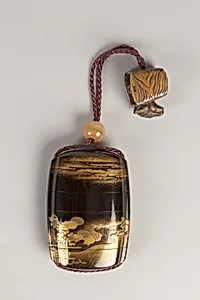
Case (Inrō) with Design of Chrysanthemums by a Stream
Unknown Artist
19th century
Medium
Sprinkled gold lacquer; Ojime: agate, Netsuke: carved wood frog on old bucket
Dimensions
3 5/16 x 2 5/16 x 1 in. (8.4 x 5.8 x 2.5 cm)
Classification
Inrō
Culture & Period
Japan · Edo period (1615–1868)
Department
Asian Art
Museum
Metropolitan Museum of Art, New York, NY
Credit
Rogers Fund, 1913
Accession Number
13.67.48
Rights
Public Domain
Tags
Art Historical Context
This delicate *Inrō*, or lacquered case, from Japan's Edo period (1615–1868) served as a portable container for medicines, seals, or tobacco, suspended from a kimono sash by a silk cord. Measuring just over 3 inches tall, it exemplifies the period's refined craftsmanship for everyday carry. The case fastens with an agateojime*—a sliding bead that cinches the cord—and a whimsical carved wood *netsuke* depicting a frog perched on an old bucket, adding both utility and charm to the ensemble. Crafted in sprinkled gold lacquer, the surface shimmers with a design of chrysanthemums blooming beside a gentle stream. This technique involves applying fine gold powder to wet layers of lacquer, creating a luminous, textured effect that catches the light, a hallmark of Japanese *urushi* artistry. Chrysanthemums, tagged here for their floral motif, evoke autumn's fleeting beauty in Japanese culture. Acquired through the Rogers Fund in 1913, this 19th-century treasure from the Metropolitan Museum of Art's Asian Art collection highlights Edo Japan's mastery of functional elegance, blending practicality with poetic nature imagery for the discerning wearer.