
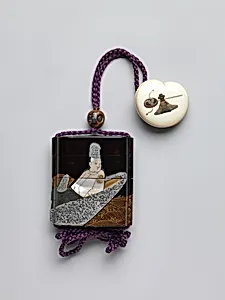
Case (Inrō) with Design of Courtier and Lady in a Boat (from the Tale of Genji)
18th century
Medium
Gold maki-e and mother-of-pearl inlay Ojime: wood-and-gilt bead in shape of sake bottle Netsuke: ivory with lacquer design of toys
Dimensions
H. 2 3/8 in. (6.1 cm); W. 2 3/16 in. (5.5 cm); D. 13/16 in. (2.1 cm)
Classification
Inrō
Culture & Period
Japan · Edo period (1615–1868)
Department
Asian Art
Museum
Metropolitan Museum of Art, New York, NY
Credit
The Howard Mansfield Collection, Purchase, Rogers Fund, 1936
Accession Number
36.100.229
Rights
Public Domain
Tags
Art Historical Context
This exquisite *inrō*, or tiered lacquer case, by the renowned Ogata Kōrin in 18th-century Japan during the Edo period (1615–1868), served as a stylish portable container for medicines, seals, or tobacco. Worn suspended from a man's kimono sash via a silk cord, it was secured by an *ojime* bead—a whimsical wood-and-gilt sake bottle—and an ivory *netsuke* with playful lacquer toy designs. Measuring just over 2 inches tall, its compact form (H. 2 3/8 in.) reflects the ingenuity of everyday luxury in urban samurai and merchant culture. The surface dazzles with a romantic scene from *The Tale of Genji*, Japan's timeless 11th-century novel by Murasaki Shikibu, depicting a courtier and lady adrift in a boat—a motif evoking fleeting romance and Heian-era courtly intrigue. Kōrin, a master of the Rinpa school, elevates this literary reference through masterful *maki-e* lacquering, where gold powder is sprinkled into wet lacquer for a shimmering effect, enhanced by iridescent mother-of-pearl inlays that catch the light like rippling water. As part of The Metropolitan Museum of Art's Howard Mansfield Collection, this piece highlights Edo Japan's artistic pinnacle, blending functionality, storytelling, and opulent craftsmanship. It invites us to ponder the elegance of a bygone era, where even the smallest accessory told a tale of beauty and sophistication.
About the Artist
Ogata Kōrin · 1658–1716
Noted as one of the most important Japanese artists of the 17th century; known for paintings of irises and other subjects. He was regarded, along with Sotatsu, as one of the masters of the Sotatsu-Koetsu school of decorative painting, including painted screens and textile designs. He was descended from a samurai who had served under the Ashikaga rulers.