
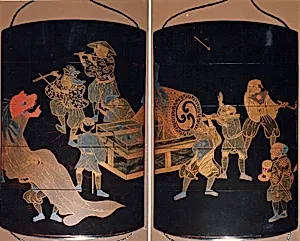
Case (Inrō) with Design of Dancer, Musicians and Drum
Unknown Artist
19th century
Medium
Lacquer, roiro, gold and coloured togidashi; Interior: nashiji and fundame
Dimensions
3 7/16 x 2 5/16 x 3/4 in. (8.7 x 5.8 x 1.9 cm)
Classification
Inrō
Culture & Period
Japan · Edo period (1615–1868)
Department
Asian Art
Museum
Metropolitan Museum of Art, New York, NY
Credit
H. O. Havemeyer Collection, Bequest of Mrs. H. O. Havemeyer, 1929
Accession Number
29.100.907
Rights
Public Domain
Tags
Art Historical Context
This exquisite *Inrō*, or lacquered case, from Japan's Edo period (1615–1868), the vibrant performing arts culture of 19th-century urban life. Worn suspended from a kimono sash by a silk cord, these compact containers—measuring just 3 7/16 x 2 5/16 x 3/4 inches—held medicines, seals, or tobacco, often paired with netsuke toggles and ojime beads as fashionable accessories for samurai, merchants, and townsmen. The exterior gleams in roiro, a mirror-like black lacquer, adorned with gold and colored togidashi-e, a technique where powdered metals are applied over lacquer, then burnished to reveal intricate designs of dancers, musicians, drums, men, and lions. These motifs evoke lively festival scenes or theatrical performances, possibly inspired by Kabuki or Noh traditions. The interior features nashiji (pearlescent gold flecks) over fundame (metallic base), adding opulent depth. A highlight of the Metropolitan Museum of Art's H.O. Havemeyer Collection, this anonymous masterpiece showcases Edo lacquerware's technical mastery and aesthetic refinement, blending functionality with artistic splendor in everyday luxury.