
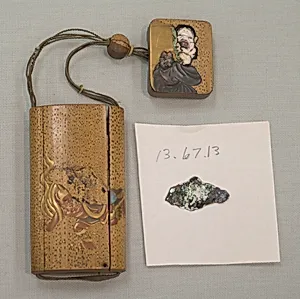
Case (Inrō) with Design of Demon in Escape
19th century
Medium
Gold, silver, red, and black hiramaki-e, takamaki-e, mother-of-pearl inlay on bamboo; interior: plain wood, drawers
Dimensions
2 13/16 x 1 9/16 x 11/16 in. (7.2 x 4 x 1.8 cm)
Classification
Inrō
Culture & Period
Japan · Meiji period (1868–1912)
Department
Asian Art
Museum
Metropolitan Museum of Art, New York, NY
Credit
Rogers Fund, 1913
Accession Number
13.67.13
Rights
Public Domain
Tags
Art Historical Context
This exquisite *Inrō* (lacquer case), crafted by Shibata Zin in Japan's Meiji period (186–1912), served as a portable accessory for men, suspended from the kimono sash to hold medicines, seals, or tobacco. Zeshin, a master lacquer artist revered as one of Japan's "Three Great Lacquerers," elevated the humble inrō into a for artistic innovation, blending traditional craftsmanship withly finesse during an era of rapid modernization. The case's surface dazzles with hiramaki-e (flat sprinkled gold and silver powder) and takamaki-e (raised gold motifs), accented by vibrant red lacquer and shimmering mother-of-pearl inlays on a bamboo core. A playful demon in mid-escape animates the design, capturing the mischievous yokai spirits of Japanese folklore. Its compact size—mere 2 13/16 x 1 9/16 x 11/16 inches—highlights the precision required for such intricate work, with plain wooden drawers inside for practicality. Acquired through the Rogers Fund in 1913, this Metropolitan Museum of Art treasure exemplifies Meiji lacquerware's global appeal, bridging Edo-period traditions with Western influences. Visitors, imagine slipping this whimsical guardian into your obi— a demon fleeing, yet forever trapped in golden splendor!
About the Artist
Shibata Zeshin · 1807–1891
Japanese, 1807–1891