
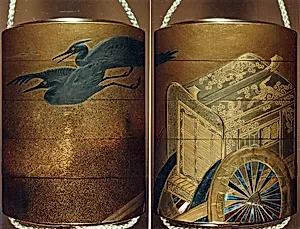
Case (Inrō) with Design of Imperial Cart and Flying Herons (obverse); Court Carriage and Flying Herons (reverse)
19th century
Medium
Gold and silver maki-e with mother-of-pearl inlay and black lacquer; Ojime: agate bead; Netsuke: metal king of hell
Dimensions
3 3/8 x 2 5/16 x 11/16 in. (8.5 x 5.9 x 1.8 cm)
Classification
Inrō
Culture & Period
Japan · Edo period (1615–1868)
Department
Asian Art
Museum
Metropolitan Museum of Art, New York, NY
Credit
H. O. Havemeyer Collection, Bequest of Mrs. H. O. Havemeyer, 1929
Accession Number
29.100.860
Rights
Public Domain
Tags
Art Historical Context
This exquisite inrō, crafted by the renowned Kajikawa School in 19th-century Japan during the Edo period, exemplifies the refined artistry of traditional Japanese lacquerware. Inrō served as portable cases for seals, medicines, or small personal items, suspended from a gentleman’s kimono sash by a cord secured with an ojime bead and netsuke toggle. Here, the toggle takes the form of a striking metal “king of hell,” creating an intriguing contrast with the case’s elegant imagery. The obverse and reverse feature imperial carts and court carriages accompanied by gracefully flying herons, rendered in gold and silver maki-e—a technique in which powdered metals are sprinkled onto wet lacquer—alongside shimmering mother-of-pearl inlays set against black lacquer. These motifs evoke themes of nobility, seasonal change, and the natural world, reflecting the refined tastes of Edo-period elites. The Kajikawa School’s mastery of layered lacquer and inlay highlights the period’s technical sophistication and appreciation for subtle luxury. Measuring just over three inches tall, this compact masterpiece from the H. O. Havemeyer Collection invites close viewing, rewarding visitors with its delicate interplay of metallic sheen, iridescent shell, and symbolic design.