
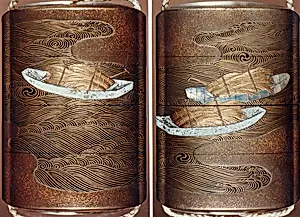
Case (Inrō) with Design of Sheaves of Rice in Boats
19th century
Medium
Gold maki-e with mother-of-pearl inlay and black lacquer Ojime: ivory Netsuke: carved bone with moon and goose
Dimensions
H. 3 1/8 in. (8 cm); W. 2 1/8 in. (5.4 cm); D. 15/16 in. (2.4 cm)
Classification
Inrō
Culture & Period
Japan · Edo period (1615–1868)
Department
Asian Art
Museum
Metropolitan Museum of Art, New York, NY
Credit
The Howard Mansfield Collection, Purchase, Rogers Fund, 1936
Accession Number
36.100.218
Rights
Public Domain
Tags
Art Historical Context
This exquisite *Inrō* (lacquered case) from the Koma School the pinnacle of Edo-period (1615–1868) Japanese craftsmanship. Dating to the 19th century, it a poetic design of sheaves of stacked in boats, evoking the rhythms of rural life, harvest abundance, and Japan's agrarian heritage. Worn suspended from a kimono sash via a silk cord, these compact cases held medicines, seals, or tobacco, serving as both practical accessories and status symbols for the prosperous merchant class during a time of peace and cultural flourishing. Crafted in black lacquer with lavish gold *maki-e*—fine gold powder sprinkled and burnished for a shimmering effect—and iridescent mother-of-pearl inlays, the piece showcases the Koma School's mastery of layered, luminous techniques. It is completed by an ivory *ojime* bead for securing the cord and a carved bone *netsuke* depicting a goose and moon, adding whimsy and seasonal symbolism (geese migrate under the moon, hinting at autumn). Measuring just 3 1/8 inches tall, its diminutive scale belies the meticulous artistry. Part of The Howard Mansfield Collection at The Metropolitan Museum of Art, this *inrō* highlights lacquerware's role in Edo Japan's material culture, blending utility, beauty, and subtle narrative to delight wearers and viewers alike.