
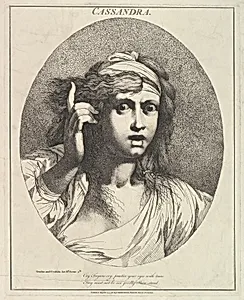
Cassandra (from "Twelve Characters from Shakespeare")
March 15, 1776
Medium
Etching
Dimensions
Plate: 15 5/8 x 12 11/16 in. (39.7 x 32.2 cm) Sheet: 21 7/16 x 15 15/16 in. (54.4 x 40.5 cm)
Classification
Prints
Department
Drawings and Prints
Museum
Metropolitan Museum of Art, New York, NY
Credit
Gift of Mrs. Olga Sichel and Max Philippson, 1962
Accession Number
62.557.203
Rights
Public Domain
Tags
Art Historical Context
John Hamilton Mortimer's *Cassandra (from "Twelve Characters from")*, etched in 1776, captures the prophetess from Shakespeare's *ilus and Cressida*. Priam's daughter, Cassandra foresees Troy's doom but is cursed to be disbelieved, embodying themes of futile wisdom and female anguish that resonated in 18th-century Britain, where Shakespeare fever gripped artists and audiences alike. Mortimer, a pioneering British etcher and Royal Academy exhibitor (1740–1779), drew inspiration from the Bard to explore dramatic human emotion, blending neoclassical poise with emerging Romantic intensity. This etching exemplifies Mortimer's mastery of the medium, using bold, expressive lines on a large plate (15⅝ × 12¹¹⁄₁₆ in.) to convey Cassandra's wild-haired frenzy and prophetic despair. Etching allowed for rich tonal contrasts and intricate detail, making prints accessible yet prestigious for collectors. Produced amid Mortimer's short but influential career—cut short by illness at 39—this work from his Shakespeare series highlights his flair for theatrical character studies, bridging history painting and graphic art. Today, housed in the Metropolitan Museum of Art's Drawings and Prints department (gift of Mrs. Olga Sichel and Max Philippson, 1962), it invites visitors to ponder timeless Shakespearean women, whose voices echo across centuries.
About the Artist
John Hamilton Mortimer|William Shakespeare · 1740–1779
Comment on works: History; Portraits; Genre