
Cassetta frame
Unknown Artist
1900–1910 (style early 18th century)
Medium
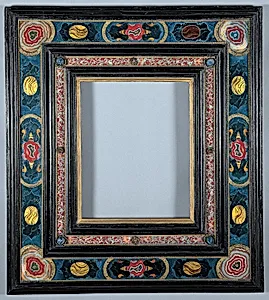
Poplar back frame with applied ebonized pearwood upper moldings; glass. Half-lapped back frame. Sight edge: oil gilt. Friezes: verre églomisé, or reverse-painted glass, held in with bronze-colored ripple moldings and gilt-bronze panel ends, and painted to resemble stone mosaic.
Dimensions
Overall: 34 3/8 × 30 7/8 in. (87.3 × 78.4 cm) Sight: 16 1/4 × 12 15/16 in. (41.2 × 32.8 cm) Rabbet: 16 15/16 × 13 11/16 in. (43 × 34.7 cm)
Classification
Frames
Culture
Italian, Rome
Department
Robert Lehman Collection
Museum
Metropolitan Museum of Art, New York, NY
Credit
Robert Lehman Collection, 1975
Accession Number
1975.1.2297
Rights
Public Domain
Art Historical Context
This exquisite *Cassetta frame*, crafted in Rome around 1900–1910, revives the elegant early 18th-century of Italian Baroque framing. Cassetta frames, meaning "little box" in Italian, feature a flat, panel structure that creates a sense of depth and architectural poise, originally popular from the Renaissance onward for housing paintings. Made from poplar with applied ebonized pearwoodings, this frame measures 34 3/8 × 30 7/8 inches overall, its sight edge gleaming with oil gilding for a luxurious finish. What sets it apart are the friezes employing *verre églomisé*—reverse-painted glass mimicking intricate stone mosaics. These panels, secured by bronze-colored ripple moldings and gilt-bronze ends, showcase masterful trompe-l'œil techniques, blurring the line between painting and sculpture. Half-lapped joinery on the back ensures sturdy construction, highlighting the frame-makers' precision. From the Robert Lehman Collection at The Metropolitan Museum of Art, this frame exemplifies the early 20th-century revival of historic Italian craftsmanship, underscoring frames as standalone artworks that once elevated Old Master paintings. A testament to Rome's enduring frame-making tradition, it invites visitors to appreciate the unsung artistry framing our greatest treasures.