
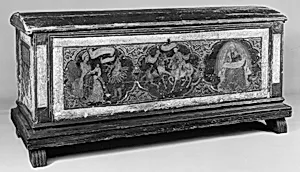
Cassone (one of a pair)
second quarter 15th century
Medium
Tempera on lindenwood, molded and gilt ornament
Dimensions
29 1/2 x 62 1/4 x 23 3/4 in. (74.9 x 158.1 x 60.3 cm)
Classification
Woodwork-Furniture|Paintings
Culture
Italian, probably Florence
Department
European Sculpture and Decorative Arts
Museum
Metropolitan Museum of Art, New York, NY
Credit
Bequest of George Blumenthal, 1941
Accession Number
41.190.130
Rights
Public Domain
Tags
Art Historical Context
This exquisite *cassone*, one of a lively painted pair from the second quarter the 15th century hails from Italy—likely Florence—and served as a wedding chest for storing a bride's dowry linens and treasures. Cassoni like this were prized status symbols in Renaissance households, often commissioned for elite marriages to display wealth and virtue through elaborate decoration. Adorned with molded and gilt ornamentation, its lindenwood body—light yet sturdy—provided an ideal surface for storytelling panels that brought classical tales or moral narratives to life. Crafted in tempera on wood, a hallmark of early Renaissance painting before oil's dominance, the anonymous Florentine artist's technique layered vibrant pigments with egg-based medium for luminous, jewel-like colors and fine details. Scenes teeming with men, women, children, and horses evoke dynamic processions or heroic episodes, blending everyday domesticity with idealized antiquity. The gilt accents catch the light, mimicking gold leaf in panel paintings and elevating this functional furniture to sculptural art. Bequeathed to the Metropolitan Museum of Art in 1941 by George Blumenthal, this cassone offers a window into Florentine workshops where painters and woodworkers collaborated, fusing utility with artistry in the dawn of the Renaissance. (198 words)
About the Artist
Italian (Florentine?) Painter (Italian) · –