
Caster
1750–70
Medium
Silver
Dimensions
Overall: 5 x 1 15/16 in. (12.7 x 4.9 cm); 3 oz. 6 dwt. (102.5 g) Foot: Diam. 1 3/4 in. (4.4 cm) Body: H. 2 13/16 in. (7.1 cm); 2 oz. 6 dwt (71.7 g) Cover: H. 2 7/16 in. (6.2 cm); 1 oz. (30.8 g)
Classification
Caster
Culture
American
Department
The American Wing
Museum
Metropolitan Museum of Art, New York, NY
Credit
Bequest of Alphonso T. Clearwater, 1933
Accession Number
33.120.213
Rights
Public Domain
Art Historical Context
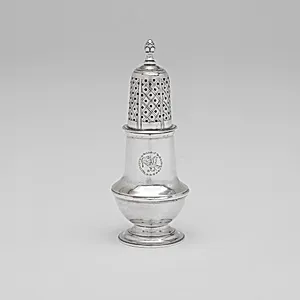
Welcome to The American Wing, where this exquisite silver caster by Mark Nelson (active mid-18th century) us to colonial America around 1750–70. Crafted from gleaming weighing a precise 3 oz. 6 dwt. (102.5 g), it stands just 5 inches tall, with a foot of 1 3/4 inches in diameter. Casters like this were essential tableware for affluent households, used to sprinkle sugar, salt, or spices during meals—a mark of refined hospitality in era when silver symbolized wealth and status. Mark Nelson, a skilled American silversmith, exemplifies the craftsmanship of the period, when artisans drew inspiration from British and European designs adapted to local tastes. The caster's modular form—body (2 13/16 in. high, 71.7 g), cover (2 7/16 in. high, 30.8 g), and foot—highlights meticulous silversmithing techniques, likely involving casting, chasing, and soldering for both functionality and elegance. Such pieces were heirlooms, passed down through generations. Bequeathed to the Metropolitan Museum of Art in 1933 by Alphonso T. Clearwater, this caster offers a tangible link to everyday luxury in pre-Revolutionary America, reminding us how silversmiths like Nelson elevated the ordinary into art. A closer look reveals the enduring shine of colonial ingenuity!