
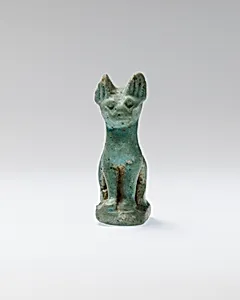
Cat Amulet
Unknown Artist
664–332 B.C.
Medium
Blue faience
Dimensions
H. 3.2 × W. 1.1 × D. 1.7 cm (1 1/4 × 7/16 × 11/16 in.)
Classification
Amulet, cat
Period
Late Period
Department
Egyptian Art
Museum
Metropolitan Museum of Art, New York, NY
Credit
Gift of Darius Ogden Mills, 1904
Accession Number
04.2.375
Rights
Public Domain
Tags
Art Historical Context
Nestled in the Egyptian Art collection at the Metropolitan Museum of Art, this *Cat Amulet* (H. 3.2 × W. 1.1 × D. 1.7 cm) captures the Late Period's devotion to feline guardians, dating from 664–332 B.C. during Dynasties 26–30. Crafted from vibrant blue faience—a glazed composite of quartz, lime, and clay fired to mimic precious lapis lazuli—this tiny sculpture exemplifies Egypt's mastery of small-scale luxury goods. The medium's glossy sheen and enduring color evoked the Nile's life-giving waters, making it ideal for amulets worn close to the body for protection. In ancient Egypt, cats symbolized power, fertility, and divine watchfulness, often linked to Bastet, the goddess of home and pleasure whose cult thrived in the Late Period. Such amulets were ubiquitous talismans, suspended from necklaces or placed in tombs to ward off evil and ensure safe passage to the afterlife. This unknown artist's precise modeling of the cat's alert posture and detailed ears highlights the era's refined sculptural techniques, blending everyday piety with artistic elegance. A generous gift from Darius Ogden Mills in 1904, this charming artifact invites us to ponder the ancient Egyptians' tender bond with their whiskered companions—proof that cats have ruled hearts for millennia!