
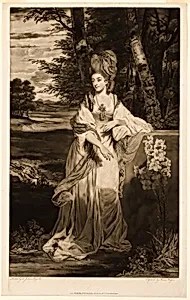
Catherine, Lady Bampfylde
1779
Medium
Mezzotint on laid ivory paper
Dimensions
Image: 59.9 × 37.8 cm (23 5/8 × 14 15/16 in.); Plate: 63.8 × 37.9 cm (25 1/8 × 14 15/16 in.); Sheet: 65.1 × 41.2 cm (25 11/16 × 16 1/4 in.)
Classification
mezzotint
Department
Prints and Drawings
Museum
Art Institute of Chicago
Accession Number
26781
Rights
Public Domain
About this artwork
Considered one of the greatest of all English mezzotints, this print of Lady Catherine Bampfydle demonstrates precisely why artists in 18th-century Britain adopted the process in such earnest. During this time, mezzotint was primarily used to translate oil paintings into printed form rather than for original expression. This portrait of Lady Bampfydle exemplifies the delicate uses of half tones to convey rich texture and depth. Reynolds’s model contributes its witty adaptation in reverse of the ...
Art Historical Context
**Catherine, Lady Bamplde** is a striking 1779 mezzotint English engraver Thomas Watson, the elegance of this aristocratic sitter on laid ivory paper. Measuring nearly 24 by 15 inches in its image area, the print exemplifies the refined portraiture of late 18th-century Britain, a time when mezzotints like this one served as affordable reproductions of high-society oil paintings, bringing the glamour of nobility into middle-class homes. Mezzotint, Watson's specialty, revolutionized printmaking with its velvety blacks and subtle gradations. The technique begins with a roughened copper plate that holds rich ink, then is smoothed by the artist to create luminous highlights—ideal for conveying the soft textures of lace, skin, and fabrics in portraits. Watson, active in London during the Georgian era, mastered this "black manner" to emulate the painterly effects of masters like Gainsborough and Reynolds, making his works highly sought after. Housed in the Art Institute of Chicago's Prints and Drawings department, this piece highlights the cultural role of prints in democratizing portraiture. It offers a window into 1770s fashion and status, where such images reinforced social hierarchies while showcasing technical virtuosity. A testament to mezzotint's golden age, it invites visitors to appreciate the interplay of light and shadow in everyday elegance.