
Cauliculi frame
Unknown Artist
19th century (?), style early 18th century
Medium
Single piece of poplar with a horizontal grain.
Dimensions
Overall: 13 3/4 × 10 5/8 in. (35 × 27 cm) Sight: 7 3/8 × 5 1/8 in. (18.7 × 13 cm) Rabbet: 7 7/8 × 5 1/2 in. (20 × 14 cm)
Classification
Frames
Culture
Italian, Bologna
Department
Robert Lehman Collection
Museum
Metropolitan Museum of Art, New York, NY
Credit
Robert Lehman Collection, 1975
Accession Number
1975.1.2128
Rights
Public Domain
Art Historical Context
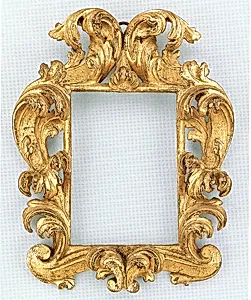
Welcome to the Robert Lehman Collection at The Metropolitan Museum of Art, where the **Cauliculi** showcases the refined artistry of Bologna, Italy. Crafted in the early 18th-century style—though possibly dating to the 19th century—this frame exemplifies Bolognese woodworking traditions, a hub of Baroque and Rococo innovation. Its name evokes *cauliculi*, the delicate, budding acanthus leaves common in classical architectural ornament, suggesting intricate carved motifs that would elegantly encase a painting, enhancing its dramatic presence. Made from a single piece of poplar wood with distinctive horizontal grain, the frame measures 13¾ × 10⅝ inches overall, with a sight opening of 7⅜ × 5⅛ inches. This construction technique highlights masterful joinery and material economy, allowing for seamless carving without visible seams—a testament to the artisan's skill in an era when frames were as vital to composition as the artwork itself. Poplar's fine texture was ideal for detailed relief work, capturing light and shadow to mimic stone entablatures. Though by an unknown artist, this frame's cultural importance lies in its role as a "window" to Italian decorative arts, bridging architecture and painting. Acquired in 1975, it invites us to appreciate how such frames elevated Bologna's artistic legacy, framing not just canvases, but centuries of aesthetic harmony.