
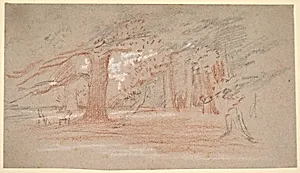
Cedar Trees in a Park
1840–70
Medium
Black, red and white chalk on brown paper
Dimensions
Sheet: 4 5/16 × 7 5/8 in. (10.9 × 19.4 cm)
Classification
Drawings
Department
Drawings and Prints
Museum
Metropolitan Museum of Art, New York, NY
Credit
Purchase, Brooke Russell Astor Bequest, 2013
Accession Number
2013.91
Rights
Public Domain
Tags
Art Historical Context
George Richmond's *Cedar Trees in a Park* (ca. 1840–70) is a delicate landscape drawing that captures the majestic forms of cedar trees in a serene park setting. Richmond, a prominent British artist and early associate of William Blake and Samuel Palmer, belonged to the visionary "Ancients" circle, which emphasized nature's spiritual depth. Created during the Victorian era, when public parks were emerging as symbols of leisure and urban escape, this work reflects Romantic ideals of sublime natural beauty amid industrialization. Executed in black, red, and white chalk on brown paper—a favored 19th-century technique for quick, expressive studies—the drawing leverages the toned ground to brilliant effect. The brown paper serves as a mid-tone, allowing white chalk to sculpt luminous highlights on foliage and bark, while black and red deepen shadows and add warmth. This method, common in sketchbooks of the period, enabled artists like Richmond to explore light and texture with economical precision, often as preparatory works or personal meditations. Housed in the Metropolitan Museum of Art's Drawings and Prints department, this intimate sheet (just 4 5/16 × 7 5/8 in.) invites close viewing, revealing Richmond's meticulous observation of tree forms. It exemplifies how Victorian draftsmen elevated everyday park scenes into poetic evocations of nature's enduring presence.
About the Artist
George Richmond · 1809–1896
British, Brompton 1809–1896 London