
Ceiling Design
18th century
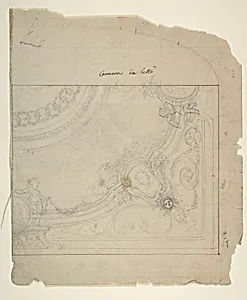
Medium
Leadpoint or graphite; framing line in pen and brown ink
Dimensions
8 9/16 x 10 1/8 in. (21.8 x 25.7 cm); irregularly cut
Classification
Drawings
Department
Drawings and Prints
Museum
Metropolitan Museum of Art, New York, NY
Credit
Purchase, Joseph Pulitzer Bequest, 1965
Accession Number
65.653.69
Rights
Public Domain
Tags
Art Historical Context
Behold the intricate *Ceiling Design* by Marini, an 18th-century Italian artist whose preparatory sketches capture the grandeur of architectural ornamentation. Created as a study for elaborate ceiling decorations, this drawing exemplifies the period's fascination with opulent interiors, likely intended for palaces or churches where vaulted surfaces demanded bold, illusionistic patterns. Housed in the Metropolitan Museum of Art's Drawings and Prints department, was acquired through the Joseph Pulitzer Bequest in 1965, preserving a glimpse into the creative process of Baroque-era design. Rendered in leadpoint or graphite—fine, precise media favored for their subtlety and erasability—Marini sketched fluid lines to map out motifs, then accented the composition with a framing line in pen and brown ink for emphasis. Measuring 8 9/16 x 10 1/8 inches (21.8 x 25.7 cm) and irregularly cut, it hints at a working draft pulled from a larger sheet, underscoring the iterative nature of 18th-century draftsmanship. This modest yet masterful sheet invites us to imagine the vibrant frescoes or stuccowork it may have inspired, bridging the gap between idea and realized splendor.
About the Artist
Leonardo Marini · 1730–1797
Leonardo Marini (1730–1797) was an Italian sculptor who worked principally in Rome during the later decades of the eighteenth century, contributing to the rich culture of sculptural production that flourished in the city during the age of Neoclassicism. Born in 1730, Marini trained within the Roman tradition of marble carving and decorative sculpture, absorbing the technical standards demanded by ...