
Ceiling Design
late 19th century
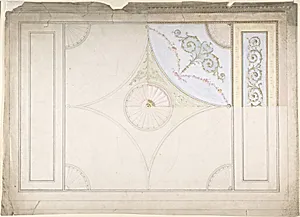
Medium
Pen and ink and watercolor
Classification
Drawings|Ornament & Architecture
Department
Drawings and Prints
Museum
Metropolitan Museum of Art, New York, NY
Credit
Gift of the Royal Institute of British Architects, 1961
Accession Number
61.669.17
Rights
Public Domain
Tags
Art Historical Context
This delicate *Ceiling Design*, created by an anonymous British artist in the late19th century, offers a glimpse into the ornate architectural imagination of Victorian Britain. Rendered in pen and ink with watercolor, it exemplifies the preparatory drawings used by architects and designers to envision elaborate ceiling decorations for grand interiors, such as public halls, theaters, or opulent homes. The medium's precision—fine ink lines for intricate patterns paired with watercolor's subtle hues—allowed for detailed planning of motifs like floral garlands, geometric panels, or classical motifs, bridging the gap between sketch and execution. In the context of 19th-century British design, such works reflect the era's fascination with historicism and revival styles, from Gothic to Renaissance, amid the Industrial Revolution's push for lavish embellishment. Housed in the Metropolitan Museum of Art's Drawings and Prints department as a gift from the Royal Institute of British Architects in 1961, this piece underscores the institute's role in preserving architectural heritage. Though anonymous, it captures the collaborative spirit of the time, where skilled draftsmen contributed to Britain's rich legacy of ornamental architecture. Visitors will appreciate how this unassuming drawing reveals the artistry behind the grandeur we admire in period buildings today—a testament to the unsung creativity that adorned the skies above Victorian rooms.
About the Artist
Anonymous, British, 19th century · 1800–1900
**Anonymous, British, 19th century** is not the name of a single individual but a standard museum attribution used for works whose creators remain unidentified yet are clearly British and date to the 1800s. Major institutions, including the Metropolitan Museum of Art, employ this designation for hundreds of drawings, prints, designs, and decorative studies that lack signatures or firm documentary ...