
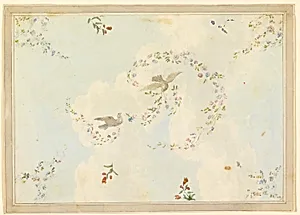
Ceiling Design with Doves and Flower Garlands, possibly for the Entrance Hall
Medium
interiors
Classification
interiors
Department
Smithsonian Collection
Museum
Smithsonian American Art Museum
Credit
Museum purchase through gift of Mrs. John Innes Kane
Accession Number
1948-40-179
Rights
Public Domain
About this artwork
Research in Progress
Art Historical Context
Frederick Crace (1779–1859), a prominent English interior decorator from a renowned family of designers, created this *Ceiling Design with D and Flower Garlands, for the Entrance Hall* 1815 and 1822. Working during the Regency era, Crace specialized in opulent interiors for British aristocracy and royalty, often blending neoclassical elegance with naturalistic motifs. This design exemplifies his expertise in decorative schemes, likely rendered as a preparatory watercolor or gouache for a grand architectural space. The composition features doves—symbols of peace and love—and cascading flower garlands, evoking the pastoral idylls of classical antiquity revived in Regency taste. Such ceiling decorations were hallmarks of early 19th-century English interiors, transforming entrance halls into welcoming, symbolic thresholds that impressed visitors with their lightness and harmony. Crace's firm supplied paper hangings and designs to luminaries like the Prince Regent, reflecting the era's fascination with symmetry, botany, and subtle symbolism amid post-Napoleonic optimism. Now in the Smithsonian American Art Museum's collection (museum purchase through the gift of Mrs. John Innes Kane), this piece offers a glimpse into Regency decorative arts. Ongoing research promises deeper insights, but it already highlights Crace's role in shaping domestic splendor that influenced American tastemakers.