
Ceiling tiles
Unknown Artist
mid-16th century
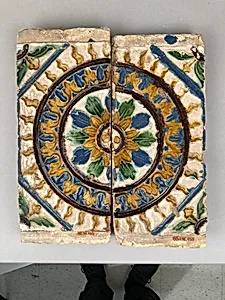
Medium
Tin-glazed earthenware
Dimensions
Each tile: 11 5/8 × 5 in. (29.5 × 12.7 cm)
Classification
Ceramics-Pottery
Culture
Spanish, Seville
Department
European Sculpture and Decorative Arts
Museum
Metropolitan Museum of Art, New York, NY
Credit
Gift of Myron and Anabel Taylor Foundation Inc., 1960
Accession Number
60.119.482–.490
Rights
Public Domain
Art Historical Context
These exquisite ceiling tiles, crafted in mid-16th-century Seville, Spain, exemplify the golden age of Spanish ceramics. Produced during the Renaissance, when Seville emerged as a thriving hub for pottery production, these tin-glazed earthenware pieceseach measuring 11 5/8 × 5 in.) were designed for architectural decoration, adorning ceilings in grand homes, palaces, or religious buildings. Their modest size allowed for intricate patterns to cover vast surfaces, transforming ordinary spaces into dazzling displays of artistry. The tin-glaze technique—applying a tin oxide coating over earthenware to create a smooth, opaque white ground—was revolutionary for its time. It enabled bold, vibrant colors that resisted fading and provided a durable finish ideal for humid climates. Rooted in Islamic traditions brought to Spain via the Moors, this method evolved under Spanish craftsmanship, blending Mediterranean influences with emerging Renaissance aesthetics. Housed in the Metropolitan Museum of Art's European Sculpture and Decorative Arts department (gift of the Myron and Anabel Taylor Foundation Inc., 1960), these tiles offer a tangible glimpse into Seville's cultural prestige as a center of trade and innovation. They highlight how everyday materials became vehicles for opulent beauty, inviting us to imagine the lively interiors of 16th-century Spain.