
Celery Vase
Unknown Artist
ca. 1850
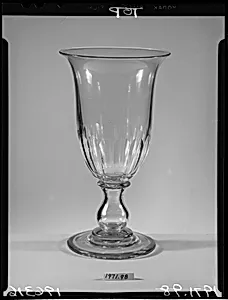
Medium
Cut blown glass
Dimensions
H. 9 1/4 in. (23.5 cm); Diam. 5 5/16 in. (13.5 cm)
Classification
Celery vase
Culture
American
Department
The American Wing
Museum
Metropolitan Museum of Art, New York, NY
Credit
Gift of Berry B. Tracy, 1971
Accession Number
1971.98
Rights
Public Domain
Art Historical Context
This elegant Celery Vase, around 1850 by an unknown glassmaker, exemplifies the refined decorative arts of mid-19-century America. Standing at 9¼ inches tall with a diameter of 5⅜ inches, it was designed to hold fresh celery stalks at the dining table—a popular Victorian-era vessel that showcased abundance and hospitality. Housed in The American Wing of the Metropolitan Museum Art, it was generously gifted by Berry B. Tracy in 1971, highlighting its enduring value as a snapshot of everyday luxury. The vase's medium, cut blown glass, reveals masterful 19th-century techniques. Glass was first blown into shape, then meticulously cut with intricate patterns using wheels and abrasives, creating sparkling facets that caught the light and elevated simple glassware to ornamental heights. This labor-intensive process was a hallmark of American glass production in centers like Pittsburgh and New England, where factories competed to produce affordable yet sophisticated tableware for the growing middle class. As a cultural artifact, the Celery Vase reflects America's burgeoning industrial prowess and social aspirations during the antebellum period. Celery, once a rare import, became a status symbol when cultivated domestically, making such vases essential for formal entertaining. Though unsigned, its pristine form invites us to appreciate the anonymous artisans whose skill turned utilitarian objects into heirlooms.