
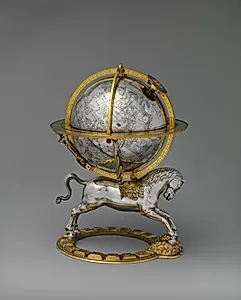
Celestial globe with clockwork
1579
Medium
Partially gilded silver, gilded brass (case); brass, steel (movement)
Dimensions
wt. (without mechanism) confirmed: 10 3/4 × 8 × 7 1/2 in., 86.412oz. (27.3 × 20.3 × 19.1 cm, 2450g) Diameter (globe): 5 1/2 in. (14 cm) Clockwork mechanism only, wt. confirmed: 35.27oz. (1000g)
Classification
Metalwork-Silver In Combination
Culture
Austrian, Vienna
Department
European Sculpture and Decorative Arts
Museum
Metropolitan Museum of Art, New York, NY
Credit
Gift of J. Pierpont Morgan, 1917
Accession Number
17.190.636
Rights
Public Domain
Tags
Art Historical Context
Step into the Renaissance world of astronomy with Gerhard Emmoser's *Celestial Globe with Clock* (1579), a masterful Austrian creation from Vienna. Crafted as a luxurious metalwork piece, its case of partially gilded silver and brass encases a functional brass-and-steel clockwork mechanism, forming a 5½-inch (14 cm) diameter globe that elegantly depicts the heavens. Weighing over 8 pounds without its intricate movement, this object blends opulent decoration with scientific precision, now housed in the Metropolitan Museum of Art's European Sculpture and Decorative Arts collection—a gift from J. Pierpont Morgan in 1917. Emmoser, a renowned goldsmith, exemplifies the era's fusion of art and emerging science during the late 16th century, when celestial mapping captivated scholars and rulers. The globe's gilding highlights starry constellations, including the mythical Pegasus, evoking the wonder of the cosmos as understood through Ptolemaic and early modern astronomy. Its clockwork innovation allowed the sphere to rotate, simulating nightly celestial motion—a rare marvel in decorative arts. This piece underscores Vienna's status as a hub for virtuoso metalworking, where functionality met artistry in silver combinations. Visitors, marvel at how it captured the Renaissance spirit: a gilded portal to the stars, inviting us to ponder humanity's timeless gaze skyward.