
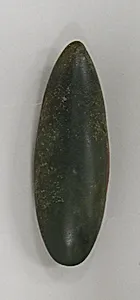
Celt
Unknown Artist
10th–15th century
Medium
Stone
Dimensions
Height 3-3/8 in.
Classification
Stone-Implements
Culture
Taíno
Department
Arts of Africa, Oceania, and the Americas
Museum
Metropolitan Museum of Art, New York, NY
Credit
Bequest of Arthur M. Bullowa, 1993
Accession Number
1994.35.416
Rights
Public Domain
Art Historical Context
This petite stone celt, standing just 3-3/8 inches tall, hails from the Taíno culture of the Caribbean, crafted between the 10th and 15th centuries. Belonging to the pre-Columbian indigenous peoples of the Greater Ant—such as modern-day Cuba, Jamaica, Hispaniola, and Puerto Rico—the Tano were skilled artisans who shaped everyday stone into tools essential for survival and ritual. Displayed in the Metropolitan Museum Art's Department of Arts of Africa,, and the Americas, this implement was generously bequeathed by Arthur M. Bullowa in 1993. Celts like this one were meticulously ground and polished from hard stone, showcasing the Taíno's advanced lithic technology without metal tools. Functioning primarily as axe heads hafted to wooden handles, they served practical purposes like clearing vegetation in lush tropical environments or woodworking for dugout canoes and sacred wooden sculptures known as *zemis*. Yet, their refined forms suggest ceremonial value too, embodying the Taíno's deep connection to nature and cosmology. In a museum context, this celt offers a tangible glimpse into Taíno ingenuity just before European contact in 1492, highlighting a vibrant society often overshadowed in history. Its compact power reminds us how simple materials could forge complex lives.