
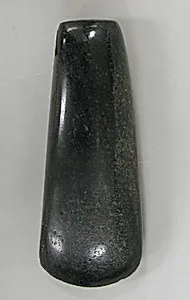
Celt
Unknown Artist
before 16th century
Medium
Stone
Dimensions
Length 4-7/8 in.
Classification
Stone-Implements
Culture
Maya (?)
Department
Arts of Africa, Oceania, and the Americas
Museum
Metropolitan Museum of Art, New York, NY
Credit
Bequest of Arthur M. Bullowa, 1993
Accession Number
1994.35.381
Rights
Public Domain
Art Historical Context
This ancient stone celt, tentatively attributed to Maya culture and dating before the 16th century, exemplifies the sophisticated stoneworking traditions of Mesoamerican peoples. Measuring just 4-7/8 inches in length, this compact tool—classified as a stone implement—was likely used as an axe or adze head for woodworking, agriculture, or ceremonial purposes.ed from carefully selected stone and polished to a smooth finish, it reflects the technical prowess of pre-Columbian artisans, transformed raw materials into functional yet elegantly proportioned objects. In Maya society, such celts held both practical and symbolic importance, possibly serving in rituals tied to fertility, warfare, or elite status. Their ground and polished surfaces demonstrate advanced grinding techniques, a hallmark of Mesoamerican lithic technology that predates metal tools. Though its exact provenance remains uncertain, this artifact offers a window into daily life and spiritual practices of a civilization renowned for its monumental architecture and intricate calendrics. Now housed in the Metropolitan Museum of Art's Department of the Arts of Africa, Oceania, and the Americas—thanks to the bequest of Arthur M. Bullowa in 1993—this celt invites visitors to ponder the ingenuity of ancient makers who shaped stone into tools of survival and reverence.