
Celt
Unknown Artist
before 16th century
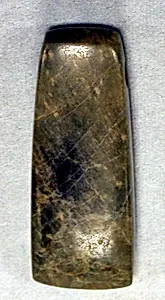
Medium
Stone
Dimensions
Height 2-3/16 in.
Classification
Stone-Ornaments
Culture
Mexico (?)
Department
Arts of Africa, Oceania, and the Americas
Museum
Metropolitan Museum of Art, New York, NY
Credit
Bequest of Arthur M. Bullowa, 1993
Accession Number
1994.35.444
Rights
Public Domain
Art Historical Context
This petite stone celt, standing just 2-3/16 inches tall, is a captivating example of pre-Columbian artistry from Mexico (or a related Mesoamerican culture), crafted before the 16th. Carved from stone and classified as an ornament, its compact form suggests it was worn as a pendant or ceremonial accessory rather than a utilitarian tool. Such objects were meticulously polished to a smooth finish, highlighting the ancient maker's skill in working hard materials with simple stone tools. In the vibrant world of pre-Hispanic Mexico, celts like this held profound cultural significance. They often symbolized power, fertility, or divine authority, appearing in elite burials or ritual contexts alongside jade and other precious stones. While its exact culture remains uncertain—possibly linked to Olmec or Maya traditions—this artifact reflects the sophisticated stoneworking traditions of indigenous peoples long before European contact. Today, housed in the Metropolitan Museum of Art's Department of the Arts of Africa, Oceania, and the Americas through the bequest of Arthur M. Bullowa in 1993, it invites us to ponder the daily lives and spiritual beliefs of ancient Mesoamericans. Its survival offers a tangible link to a world of intricate symbolism and masterful craftsmanship.