
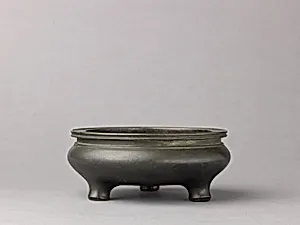
Censer
ca. 18th century
Medium
Bronze with treated surface.
Dimensions
Diameter: 13 cm.
Classification
Metalwork-Bronze
Culture
Chinese
Department
Robert Lehman Collection
Museum
Metropolitan Museum of Art, New York, NY
Credit
Robert Lehman Collection, 1975
Accession Number
1975.1.1427
Rights
Public Domain
Art Historical Context
This elegant bronze censer, crafted in China around the 18th century the Qing Dynasty, exemplifies refined metalwork traditions of imperial China. Standing at just 13 cm in diameter, it was likely designed for domestic or temple rituals, where burning incense played a central role in honoring ancestors, deities, or during Buddhist and Taoist ceremonies. Such objects bridged the spiritual and everyday worlds, filling spaces with fragrant smoke symbolizing prayers rising to the heavens. The censer's bronze medium, enhanced by a treated surface—probably a deliberate patina achieved through chemical processes—highlights masterful artisanal techniques passed down through generations. This surface treatment not only protected the metal from corrosion but also lent a rich, aged luster evoking ancient ritual bronzes from the Zhou or Han dynasties, a common Qing revival style that blended reverence for the past with contemporary elegance. Housed in the Robert Lehman Collection at The Metropolitan Museum of Art since 1975, this piece offers a window into China's enduring cultural devotion to harmony and ritual. Visitors can appreciate how such functional art objects embodied philosophical ideals, making the divine tangible in daily life.
About the Artist
Chinese
The artist known simply as "Chinese" in museum records represents the vast tradition of anonymous or unattributed masters in Chinese art history, with 99 works preserved in our collection. These pieces exemplify the enduring legacy of guó huà, or traditional Chinese painting, one of the world's oldest continuous artistic practices. Early life is not well documented, as is common for many practitio...