
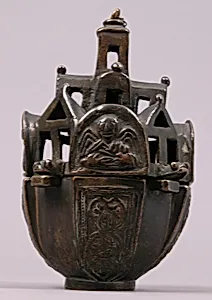
Censer
Unknown Artist
12th century
Medium
Copper alloy
Dimensions
Overall: 7 7/8 x 5 9/16 in. (20 x 14.2 cm) a only: 4 x 5 9/16 in. (10.2 x 14.2 cm) b only: 3 7/8 x 5 9/16 in. (9.8 x 14.2 cm)
Classification
Metalwork-Copper alloy
Culture
German
Department
Medieval Art
Museum
Metropolitan Museum of Art, New York, NY
Credit
Rogers Fund, 1910
Accession Number
10.18.4a, b
Rights
Public Domain
Art Historical Context
This 12th-century German censer, crafted from copper alloy, invites us into the sacred rituals of medieval Christianity. Standing just under 8 inches tall, it served as a vessel for burning incense during liturgical ceremonies, where the rising fragrant smoke symbolized prayers ascending to heaven. Produced in the Romanesque era, such censers were essential in monasteries, cathedrals, and processions across Europe, blending functionality with spiritual symbolism. Forged from durable copper alloy—a favored medium for its malleability and ability to hold intricate details— this piece exemplifies the skilled metalworking of medieval German artisans. The modular design, with separable components (overall height 7 7/8 x 5 9/16 in., or parts a and b at 4 x 5 9/16 in. and 3 7/8 x 5 9/16 in.), allowed for easy filling with incense and coals, as well as cleaning and transport. Its presence in the Metropolitan Museum of Art's Medieval Art collection, acquired through the Rogers Fund in 1910, highlights its rarity and the era's masterful blend of utility and devotion. Though the artist remains unknown, this censer reflects the cultural devotion of 12th-century Germany, where metalwork like this bridged everyday piety and divine mystery. A true treasure for contemplating medieval faith!