
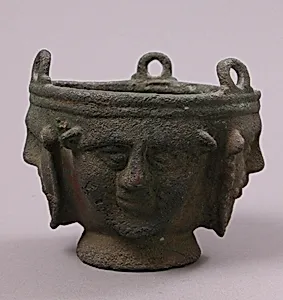
Censer
Unknown Artist
11th–14th century (?)
Medium
Copper alloy
Dimensions
Overall: 3 15/16 x 4 11/16 in. (10 x 11.9 cm)
Classification
Metalwork-Bronze
Culture
Italian (?)
Department
Medieval Art
Museum
Metropolitan Museum of Art, New York, NY
Credit
Rogers Fund, 1967
Accession Number
67.200.1b
Rights
Public Domain
Tags
Art Historical Context
Nestled in the Medieval Art collection of the Metropolitan Museum of Art, this delicate censer—acquired through the Rogers Fund in 1967—dates to the 11th–14th century and hails from possibly Italian workshops. Crafted from copper alloy, a durable material prized for its malleability and golden patina, it measures a modest 3 15/16 x 4 11/16 inches (10 x 11.9 cm). As a metalwork-bronze piece, it exemplifies the era's skilled lost-wax casting techniques, where molten metal filled intricate molds to create finely detailed forms. Censers like this were essential in Christian liturgy, swung by priests to disperse fragrant incense during Masses, symbolizing prayers rising to heaven. Its small scale suggests use in portable or private devotions, while the prominent faces—likely sculpted in high relief—add a human touch, perhaps evoking saints, angels, or donors. These enigmatic features reflect medieval artistry's blend of functionality and spirituality, where everyday ritual objects became vessels of devotion. Though the artist remains unknown, this censer's survival speaks to the enduring craft of Italian (or regional) metalworkers, bridging Romanesque solidity and Gothic elegance in a time of fervent faith. A quiet testament to medieval piety, it invites us to imagine the swirl of incense in candlelit chapels long ago.