
Center Table
c. 1820
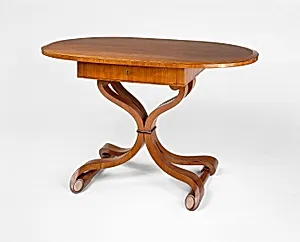
Medium
Cherrywood and metal
Dimensions
76.2 × 126.4 × 73.1 cm (30 × 49 3/4 × 28 3/4 in.)
Classification
table
Department
Applied Arts of Europe
Museum
Art Institute of Chicago
Accession Number
111298
Rights
Public Domain
About this artwork
In the years following the Napoleonic Wars, Austria played a crucial role in maintaining Europe’s political stability. Its conservative government suppressed political activism among the middle classes, encouraging them to focus instead on domestic comfort and family life. In response Vienna’s furniture makers adapted the grand Neoclassicism of earlier decades into a simpler, more modest style suited to middle-class use. Named after the fictional character Gottlieb Biedermeier—Bieder is German f...
Art Historical Context
Created around 1820 by Austrian craftsman Josef Ulrich Danhauser, this Center Table stands as a fine example of early nineteenth-century European furniture. Made from warm cherrywood accented with metal, its balanced proportions—roughly 30 by 50 by 29 inches—were designed to anchor a room while offering both surface space and visual appeal. Housed in the Art Institute of Chicago’s Applied Arts of Europe department, the table reflects the era’s focus on refined domestic objects that blended utility with understated elegance. Danhauser’s careful selection of wood grain and metal details demonstrates the high standards of Viennese workshop production, where furniture served as both practical furnishing and a marker of cultural sophistication. Such center tables were often placed in drawing rooms or salons, inviting conversation and display. Today it offers visitors a tangible connection to the period’s emphasis on craftsmanship that elevated everyday living.