
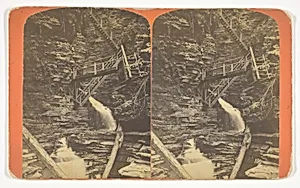
Central Gorge and Jacob's Ladder, stereo, No. 157 from the series "Havana Glen Scenery"
1860/99
Medium
Albumen print
Dimensions
Each image: 10.7 × 7.9 cm (4 1/4 × 3 1/8 in.); Card: 10.9 × 17.7 cm (4 5/16 × 7 in.)
Classification
stereograph (albumen)
Department
Photography and Media
Museum
Art Institute of Chicago
Accession Number
59744
Rights
Public Domain
About this artwork
Text printed on reverse of stereocard: This Glen is situated near the village of Havana, Schuyler County, N. Y. The latter point is accessible several times daily, by the trains of the Northern Central R. R., which connect with the Erie at Elmira, and at Canandaigua with the New York Central. Visitors coming by Steamers over Seneca Lake can take the Cars at Watkins, three miles from Havana, or may enjoy a pleasant drive of four miles from the Steamboat Landing at the entrance of the Glen.
Art Historical Context
This stereograph by G. F. Gates captures the dramatic Central Gorge and Jacob’s Ladder in Havana Glen, New York, presenting viewers with a striking view of the region’s rocky cliffs and winding paths. as an albumen print 1860 and 1899, the belongs to the photographer’s “Havana Glen Scenery” series. Each image measures just over four inches wide, mounted side-by-side on a card designed for a stereoscope—an optical device that merges the pair into a single, three-dimensional scene. Stereographs like this one were immensely popular in the nineteenth century, allowing people to experience distant or rugged landscapes from the comfort of their parlors. Albumen prints, the dominant photographic medium of the era, offered fine detail and rich tonal range that heightened the illusion of depth. Gates’s careful framing emphasizes both the scale of the gorge and the engineering feat of the ladder, inviting contemplation of nature’s power and human ingenuity. Today, the resides in the Art Institute of Chicago’s Department of Photography and Media, where it preserves a vivid record of Victorian-era tourism and the early fascination with immersive visual technologies.