
Central Portion of a Tabernacle
Unknown Artist
ca. 1275–1300
Medium
Ivory
Dimensions
Overall: 6 15/16 x 5 3/8 x 11/16 in. (17.7 x 13.7 x 1.7 cm)
Classification
Ivories
Culture
French
Department
Medieval Art
Museum
Metropolitan Museum of Art, New York, NY
Credit
Gift of J. Pierpont Morgan, 1917
Accession Number
17.190.197
Rights
Public Domain
Tags
Art Historical Context
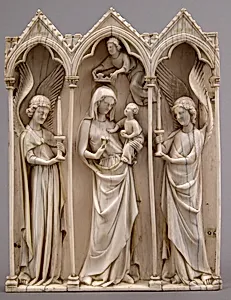
This delicate ivory carving, the *Central Portion of a Tabernacle*, dates to around 1275–1300 and hails from medieval France. Crafted during the High Gothic period, once formed the heart of a larger devotional shrine, likely used for private prayer or altar decoration in a church or noble household. Measuring just under 7 inches tall, its slender dimensions highlight the exquisite skill required to sculpt such intricate details from elephant ivory—a luxurious, symbolically pure material prized by medieval artisans for its creamy translucence and carvability. At its core, the piece depicts the Madonna and Child enthroned, surrounded by adoring angels, a timeless motif of divine tenderness and heavenly worship central to Christian devotion. This imagery reflects the era's growing emphasis on the Virgin Mary's role as intercessor, popularized in Gothic art amid rising Marian cults. The unknown French sculptor's mastery shines in the flowing drapery, gentle expressions, and ethereal angel wings, achieved through fine undercutting and polishing techniques that catch the light, evoking spiritual radiance. Now housed in the Metropolitan Museum of Art's Medieval Art department—thanks to J. Pierpont Morgan's 1917 gift—this fragment invites us to marvel at Gothic ivories' blend of piety and artistry, bridging the divine with the tangible in a turbulent age.