
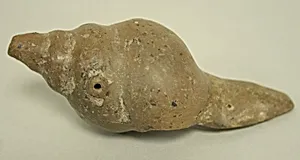
Ceramic Whistle in the Form of a Shell
Unknown Artist
5th–15th century
Medium
Ceramic
Dimensions
L. 3 7/8 in. (9.8 cm)
Classification
Ceramics-Musical Instruments
Culture
Ecuadorian
Department
Arts of Africa, Oceania, and the Americas
Museum
Metropolitan Museum of Art, New York, NY
Credit
Gift of Arthur M. Bullowa, 1983
Accession Number
1983.497.24
Rights
Public Domain
Tags
Art Historical Context
This charming Ceramic Whistle in the Form of a Shell, crafted by an unknown Ecuadorian artist between the 5th and 15th centuries, exemplifies the ingenuity of pre-Columbian pottery from South America. Measuring just under 4 inches long, this delicate ceramic piece mimics the spiraled shape of a natural seashell, likely inspired by conch shells commonly found along Ecuador's Pacific coast. Housed in the Metropolitan Museum of Art's Department of Arts of Africa, Oceania, and the Americas, it was generously gifted by Arthur M. Bullowa in 1983. In ancient Ecuadorian cultures—spanning early regional developments through periods of Manteño and later influences—this whistle served dual purposes as both a musical instrument and a sculptural object. Whistles like this were blown to produce distinctive tones, possibly used in rituals, signaling during hunting or fishing, or even as toys for children. The ceramic medium highlights advanced firing techniques that allowed for thin walls and precise detailing, ensuring the whistle's functionality while capturing the shell's textured ridges and curves with remarkable realism. Today, this artifact offers a window into the everyday creativity of Ecuadorian artisans, blending utility with nature's forms. Its survival over centuries speaks to the durability of their craft and the cultural reverence for the sea's bounty. Visitors, imagine the haunting notes echoing through ancient coastal villages!