
Ceramium rubrum
ca. 1853
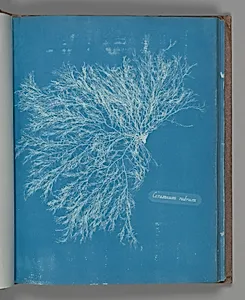
Medium
Cyanotype
Dimensions
Image: 25.3 x 20 cm (9 15/16 x 7 7/8 in.)
Classification
Photographs
Department
Photographs
Museum
Metropolitan Museum of Art, New York, NY
Credit
Gilman Collection, Purchase, The Horace W. Goldsmith Foundation Gift, through Joyce and Robert Menschel, 2005
Accession Number
2005.100.557 (37)
Rights
Public Domain
Tags
Art Historical Context
**Ceramium rubrum** Anna Atkins, created around 1853, captures the fronds of this vibrant red seaweed in exquisite detail. Atkins, a British botanist and photographer, produced this image as part of her pioneering efforts to document marine algae through photography. Displayed in the Metropolitan Museum of Art's Photographs Department (Gilman Collection, 25.3 x 20 cm), it exemplifies the intersection of science and art in the Victorian era, when naturalists sought precise visual records of the natural world. The medium, cyanotype—a cameraless photogram process invented by Sir John Herschel in 1842—holds special significance here. Atkins placed the seaweed specimen directly on sensitized paper, exposed it to sunlight, and developed it in water, yielding the signature Prussian blue tones. This technique allowed for stunningly accurate reproductions without drawing or engraving, revolutionizing botanical illustration. Atkins's work, including this piece from her *Photographs of British Algae* series, marks her as one of photography's earliest innovators. Published in book form from 1843, her cyanotypes were the first to use the medium for a complete illustrated publication, blending artistic beauty with scientific precision and influencing generations of photographers and scientists alike.
About the Artist
Anna Atkins · 1799–1871
Anna Atkins (née Children), born on March 16, 1799, in Tonbridge, Kent, England, grew up immersed in the world of science thanks to her father, John George Children, a prominent chemist, zoologist, and curator at the British Museum. After her mother Hester's death shortly after childbirth in 1800, Anna formed a close bond with her father, receiving an exceptional scientific education rare for wome...