
Ceremonial Textile (Tampan)
19th century
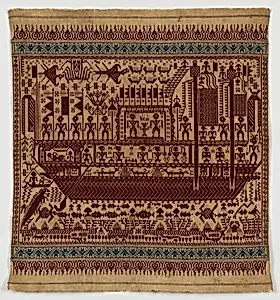
Medium
Cotton
Dimensions
L. 31 x W. 28 1/2 in. (78.7 x 72.4 cm)
Classification
Textiles-Woven
Culture
Lampung
Department
Arts of Africa, Oceania, and the Americas
Museum
Metropolitan Museum of Art, New York, NY
Credit
Gift of Anita E. Spertus and Robert J. Holmgren, in honor of Douglas Newton, 1990
Accession Number
1990.335.22
Rights
Public Domain
Tags
Art Historical Context
This exquisite *Ceremonial Textile (Tampan)*, crafted by a Lampung artist in the 19th century, hails from the Lampung people of Sumatra,. Woven from cotton and measuring 31 x 28½ inches (78.7 x 72.4 cm), it the rich textile traditions of Southeast Asian cultures, now housed in the Metropolitan Museum of Art's Department of Arts of Africa,, and the Americas.ated in 1990 in honor of curator Douglas Newton, this piece highlights the enduring gift of cultural artifacts to public appreciation. Tampan textiles held profound ceremonial importance in Lampung society, used in rituals such as weddings, funerals, and housewarmings to invoke blessings and honor ancestors. The prominent ship motifs—evident in this work—symbolize mythical voyages, often representing the journey of the soul to the afterlife or communal prosperity. These designs connected the living with spiritual realms, weaving cosmology into everyday life. Artistically, the tampan showcases masterful supplementary weft weaving on a cotton ground, a technique that allowed intricate, supplementary patterns to emerge vividly. This labor-intensive method preserved Lampung identity amid 19th-century colonial influences, offering visitors a tactile window into a vibrant heritage.