
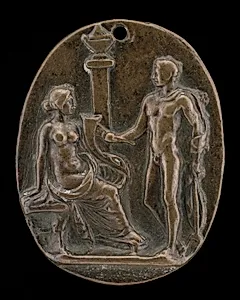
Ceres and Triptolemus
mid 15th century
Medium
bronze//Light brown patina
Dimensions
overall (oval): 4.49 x 3.52 cm (1 3/4 x 1 3/8 in.) gross weight: 28.67 gr (0.063 lb.)
Classification
Sculpture
Department
CSD
Museum
National Gallery of Art, Washington, D.C.
Credit
Samuel H. Kress Collection
Accession Number
1957.14.154
Rights
Public Domain
Art Historical Context
Behold the delicate bronze plaquette *Ceres and Triptmus*, a mid-15th-century Roman from the Samuel H. Kress Collection at the National Gallery of Art. Measuring just 4.49 x 3.52 cm and weighing a mere 28.67 grams, oval sculpture captures the Roman goddess Ceres—equivalent to the Greek Demeterbestowing gifts upon Triptolemus, mythical prince who spread agriculture across the. Its light brown patina evokes the patina of ancient bronzes, lending an aura of timeless elegance. Crafted "after the Antique," this work exemplifies the Renaissance fascination with classical antiquity. Italian artists of the 15th century avidly copied Greco-Roman motifs, reviving pagan myths to celebrate humanism and the natural world. The intricate relief technique—common in small-scale bronzes or plaquettes—allowed for portable, intimate expressions of mythology, often collected by scholars and patrons as Renaissance equivalents of ancient gems. This tiny treasure highlights the cultural bridge between ancient Rome and the Renaissance, symbolizing abundance and civilization's roots in farming. Gaze closely to appreciate the masterful chasing and modeling that breathe life into these deities, a testament to the era's technical prowess and enduring reverence for the classical past.