
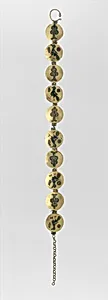
Chain with Birds and Trees of Life
Unknown Artist
1000–1200
Medium
Cloisonné enamel, gold
Dimensions
Overall: 12 7/16 x 13/16 x 1/8 in. (31.6 x 2.1 x 0.3 cm) Overall (without chain and ring): 9 11/16 x 13/16 x 1/8 in. (24.6 x 2.1 x 0.3 cm)
Classification
Enamels-Cloisonné
Culture
Kyivan Rus’
Department
Medieval Art
Museum
Metropolitan Museum of Art, New York, NY
Credit
Gift of J. Pierpont Morgan, 1917
Accession Number
17.190.705
Rights
Public Domain
Tags
Art Historical Context
Nestled in the Metropolitan Museum of Art's Medieval collection, this exquisite *Chain with Birds and Trees of Life (ca. 1000–120) hails from theivan Rus’, a East Slavic federation centered in present-day Ukraine. Crafted by an unknown artist, the piece is a masterful example of cloisonné enamel gold—a technique where thin gold wires form intricate cells filled with colored glass enamel and fired to create luminous, durable designs. Measuring about 12½ inches long, it likely served as a prestigious necklace or reliquary chain, showcasing the era's opulent jewelry traditions. The motifs of interlocking Trees of Life and stylized birds carry profound symbolism. Trees of Life evoke paradise, eternity, and the divine order in Christian iconography, while birds—common in Byzantine-influenced art—may represent souls ascending to heaven or messengers of the divine. This blend reflects Kyivan Rus’ cultural synthesis after its Christianization in 988, merging Slavic motifs with sophisticated Byzantine enameling skills imported via trade and diplomacy. A gift from J. Pierpont Morgan in 1917, this delicate treasure (just over 13/16 inch wide) highlights the technical virtuosity of Rus’ workshops, where goldsmiths achieved jewel-like vibrancy. For visitors, it offers a window into a golden age of medieval craftsmanship, where faith and artistry intertwined seamlessly.