
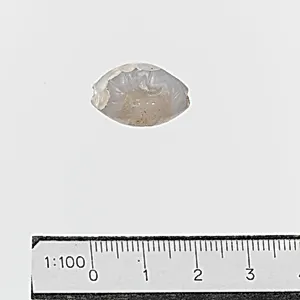
Chalcedony amygdaloid seal
Unknown Artist
ca. 1700–1450 BCE
Medium
Chalcedony
Dimensions
L. 1.85 cm; W. 1.2 cm
Classification
Gems
Culture & Period
Minoan · Middle Minoan III–Late Minoan I
Department
Greek and Roman Art
Museum
Metropolitan Museum of Art, New York, NY
Credit
Bequest of Richard B. Seager, 1926
Accession Number
26.31.186
Rights
Public Domain
Tags
Art Historical Context
This exquisite chalcedony amygdaloid seal, shaped like an almond and measuring just 1.85 cm long by 1.2 cm wide hails from the Minoan civilization of Crete, dating to around 1700–1450 BCE (Middle Minoan III– Minoan I). Carved with delicate fish motifs, it exemplifies the intricate world of Minoan gem engraving These small seals were essential, likely used to imprint clay or wax for administrative purposes, such as marking ownership or sealing documents in the bustling palace economies of sites like Knossos. Minoan art often celebrated the sea's abundance, and the fish here reflect this maritime reverence—perhaps symbolizing fertility, trade, or daily life on the island. Chalcedony, a durable microcrystalline quartz, was prized for its translucency and hardness, making it ideal for such precise work. Artisans employed fine tools to incise detailed designs, showcasing advanced lapidary skills that bridged art and utility. Bequeathed to the Metropolitan Museum of Art in 1926 by Richard B. Seager, this seal offers a window into a sophisticated Bronze Age society, where even tiny objects reveal a culture's ingenuity and aesthetic harmony with nature.