
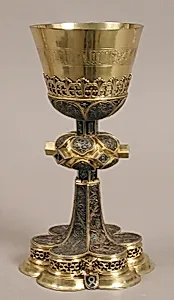
Chalice
Unknown Artist
ca. 1460–80
Medium
Cloisonné enamel, silver-gilt
Dimensions
Overall: 9 3/8 x 5 3/8 x 5 in. (23.8 x 13.7 x 12.7 cm) cup: 3 3/8 x 4 3/16 in. (8.6 x 10.6 cm)
Classification
Enamels
Culture
Hungarian
Department
Medieval Art
Museum
Metropolitan Museum of Art, New York, NY
Credit
Gift of J. Pierpont Morgan, 1917
Accession Number
17.190.368
Rights
Public Domain
Tags
Art Historical Context
Nestled in the Medieval Art collection of the Metropolitan Museum of Art, this exquisite chalice from Hungary, dating to around 1460–80, exemplifies the opulence of late medieval ecclesiastical metalwork. Crafted by an unknown artist, it measures about 9⅜ inches tall, with a silver-gilt body adorned in vibrant cloisonné enamel. The technique—creating delicate cells from thin gold wires filled with powdered glass enamel, then fired to fuse colorful designs—was prized for its luminous, jewel-like quality, bridging Byzantine traditions with Central European craftsmanship. In the Kingdom of Hungary during the Renaissance's early stirrings, such chalices held profound liturgical significance, used to contain the Eucharistic wine during Mass. Latin inscriptions, hinted at by its tags, likely invoke sacred prayers or dedications, underscoring its role in Catholic devotion amid a vibrant court culture under kings like Matthias Corvinus. The silver-gilt base and cup enhance its regal sheen, making it a treasure for both worship and display. Gifted to the Met in 1917 by financier J. Pierpont Morgan, this chalice invites us to ponder the devotion and artistry of 15th-century Hungary, where faith met masterful innovation.