
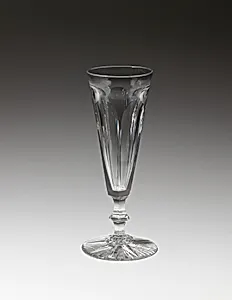
Champagne flute
Medium
blown and cut glass
Dimensions
4 7/8 in. (12.4 cm); Diam . 2 7/8 (7.3 cm)
Classification
Champagne flute
Culture
American
Department
The American Wing
Museum
Metropolitan Museum of Art, New York, NY
Credit
Gift of Solomon Grossman, 2012
Accession Number
2012.514.2
Rights
Public Domain
Art Historical Context
This delicate champagne flute, crafted by the Jersey Glass Company George Dummer between 1824 and 1835, exemplifies early 19th-century American glassmaking ingenuity. Standing just under 5 inches tall with a 2⅞-inch diameter, its slender form was designed for the effervescent sparkle of champagne, a beverage gaining popularity among America's emerging elite during the post-Revolutionary era. Made from blown and cut glass, the piece showcases sophisticated techniques: the glass was first blown into shape on a pipe for its graceful stem and bowl, then meticulously wheel-cut to create intricate patterns that catch and refract light. This labor-intensive process highlighted the skill of American artisans at factories like Jersey Glass in New Jersey, which competed with European imports by producing affordable yet refined tableware. Housed in The Metropolitan Museum of Art's American Wing, this flute—gifted by Solomon Grossman in 2012—offers a glimpse into the cultural aspirations of a young nation. It reflects the growing sophistication of American domestic life, where such elegant stemware symbolized hospitality and refinement in the bustling republic of the 1820s and 1830s.