
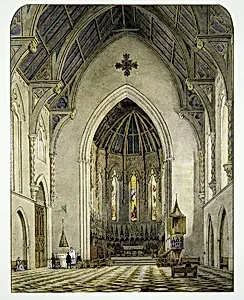
Chancel of Trinity Chapel, New York
Medium
Watercolor, gouache, black ink, graphite, and gum arabic on off-white wove paper
Dimensions
18 3/8 x 14 1/4 in. (46.7 x 36.2 cm)
Classification
Watercolor
Culture
American
Department
The American Wing
Museum
Metropolitan Museum of Art, New York, NY
Credit
The Edward W. C. Arnold Collection of New York Prints, Maps, and Pictures, Bequest of Edward W. C. Arnold, 1954
Accession Number
54.90.157
Rights
Public Domain
Tags
Art Historical Context
John William Hill’s 1856 depiction of the Chancel of Trinity Chapel captures the quiet splendor of a mid-nineteenth-century New York church interior. Working in watercolor, gouache, ink, graphite, and gum arabic on off-white paper, Hill renders the Gothic Revival sanctuary with remarkable clarity, highlighting the carved wooden altar screen, clustered columns, and richly patterned tile floor. The medium’s luminous washes and fine detail allow the light filtering through unseen windows to glow softly across stone and wood, inviting viewers to linger within the sacred space. Hill, an American artist drawn to the precise observation championed by the Pre-Raphaelite Brotherhood, brought this same meticulous approach to architectural subjects. His choice of watercolor—traditionally associated with topographical views—elevates an ordinary parish chapel into a work of enduring visual poetry. Created just four years after Trinity Chapel opened on West Twenty-Fifth Street, the drawing preserves the building’s original appearance for modern audiences. Today in the Metropolitan Museum’s American Wing, the sheet forms part of the Edward W. C. Arnold Collection, offering visitors an intimate glimpse of New York’s religious and artistic life in the 1850s.
About the Artist
John William Hill · 1812–1879
American (born England), London 1812–1879 West Nyack, New York