
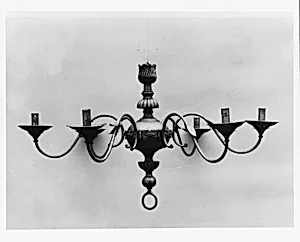
Chandelier
Unknown Artist
1670–1700
Medium
Iron, wood
Dimensions
H. 21 1/4 in. (54 cm)
Classification
Chandelier
Department
The American Wing
Museum
Metropolitan Museum of Art, New York, NY
Credit
Rogers Fund, 1923
Accession Number
23.111.1
Rights
Public Domain
Art Historical Context
This modest chandelier, crafted between 1670 and 1700 by an unknown artisan, exemplifies early American craftsmanship from the colonial period. Standing just 21¼ inches (54 cm) tall, it is fashioned from iron and wood—durable materials readily available in the New World. The iron likely features hand-forged elements, a labor-intensive technique common before widespread industrialization, while wood provided lightweight structural support, making it practical for suspension in homes or taverns. Housed in The Metropolitan Museum of Art's American Wing and acquired through the Rogers Fund in 1923, this piece offers a glimpse into everyday colonial life. During this era, lighting fixtures like chandeliers were rare luxuries, often holding candles to illuminate gatherings in sparse interiors. Its compact size suggests use in a modest household, highlighting the resourcefulness of American makers who adapted European designs to local resources. Though simple, the chandelier's survival underscores the ingenuity of 17th-century colonists, blending functionality with subtle ornamentation. It invites visitors to imagine the flicker of candlelight in a bygone era, connecting us to the roots of American decorative arts.