
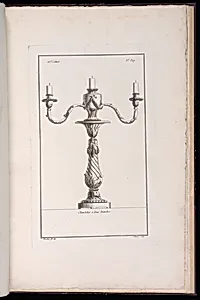
Chandelier à deux branches
Medium
Classification
Department
Smithsonian Collection
Museum
Smithsonian American Art Museum
Credit
Purchased for the Museum by the Advisory Council
Accession Number
1921-6-255-36
Rights
Public Domain
About this artwork
Research in Progress
Art Historical Context
**Chandelier à deux branches is a delicate print created around 1775 by Juste-Françoisoucher, a French artist from 1736 to 1782. This work captures the elegance of late 18th-century French design, depicting a two-branch chandelier—a symbol of opulent interiors during the Louis XVI period. As a print, it served as a practical tool for disseminating intricate ornamental motifs to artisans, goldsmiths, and cabinetmakers across Europe, reflecting the era's fascination with refined luxury and symmetry. Boucher's piece exemplifies the transition from the playful Rococo curves of his father's generation toward more restrained Neoclassical forms, blending floral swags and scrolling arms in a harmonious composition. Prints like this were vital in the decorative arts world, enabling the replication of high-style furnishings in homes and palaces. Its presence in the Smithsonian American Art Museum highlights transatlantic exchanges, as French designs inspired American craftsmen during the early republic. Acquired through the museum's Advisory Council purchase, this artwork invites visitors to appreciate the artistry behind everyday elegance. Though research continues, it stands as a window into the craftsmanship that illuminated Enlightenment-era salons. (198 words)