
Charles Baudelaire
ca. 1863
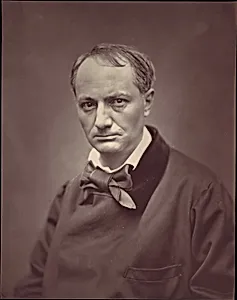
Medium
Woodburytype
Dimensions
Image: 9 1/8 × 7 1/8 in. (23.1 × 18.1 cm) Mount: 12 13/16 in. × 9 5/16 in. (32.5 × 23.7 cm)
Classification
Photographs|Prints
Department
Photographs
Museum
Metropolitan Museum of Art, New York, NY
Credit
David Hunter McAlpin Fund, 1964
Accession Number
64.677.4
Rights
Public Domain
Tags
Art Historical Context
This striking Woodburytype portrait captures the brooding intensity of Charles Baudelaire, the iconic French poet best known for his provocative collection *Les Fleurs Mal* (1857). Produced around 1863 by photographer Étienne Carjat and published by the renowned print firm Goupil et, it exemplifies the era's fascination with literary celebrities. Carjat, a master of Parisian portraiture, often immortalized intellectuals and artists, making this image a window into Baudelaire's enigmatic persona just four years before his death in 1867. The Woodburytype process, invented in the 1860s, was a groundbreaking photomechanical technique that yielded richly toned, permanent prints with exceptional detail and depth—ideal for high-quality reproductions. Unlike fragile albumen prints, these endured handling and distribution, allowing Goupil et Cie to widely disseminate elite portraits. Measuring about 9 x 7 inches on its mount, this example from the Metropolitan Museum of Art's collection highlights mid-19th-century innovations bridging photography and printmaking. Culturally, the portrait underscores Baudelaire's role as a symbol of modernism and urban decadence, his piercing gaze reflecting the bohemian spirit of Second Empire Paris. A testament to photography's rise as an art form, it invites visitors to ponder how images shaped literary legacies.
About the Artist
Goupil et Cie|Etienne Carjat (French|French) · 1850 |1828 –1884 |1906
French, active 1850–84|French, Fareins 1828–1906 Paris